
Shelby County Criminal Court Records
Criminal court records in Shelby County are kept through the Missouri circuit court system. Missouri uses circuit courts as trial courts of general jurisdiction, and Shelby County is part of the 41st Judicial Circuit with Macon County. The local court office is the Shelby County Circuit/Associate Court at the county courthouse in Shelbyville. The county site lists Circuit Judge Frederick P. Tucker, Associate Circuit Judge Mike Greenwell, and Circuit Clerk Tammy Snider for court operations. The Circuit Clerk is the practical contact for copies, docket questions, older paper files, and certified criminal case records that are not fully answered online.
A criminal court record starts when a complaint, information, indictment, or other charge filing reaches the court. The case file can include the charge history, probable-cause material if public, bond orders, plea entries, motions, docket entries, hearing settings, judgment, sentence, probation terms, and financial obligations. The narrower charge history is useful, but the full criminal court file is where the final court outcome appears. For a closer look at the filed charge path after arrest, use the body discussion on Shelby County arrest records and charges.
The Missouri court-record image from Missouri section 509.520 is relevant because redaction rules affect what appears in a public Shelby County criminal court record.
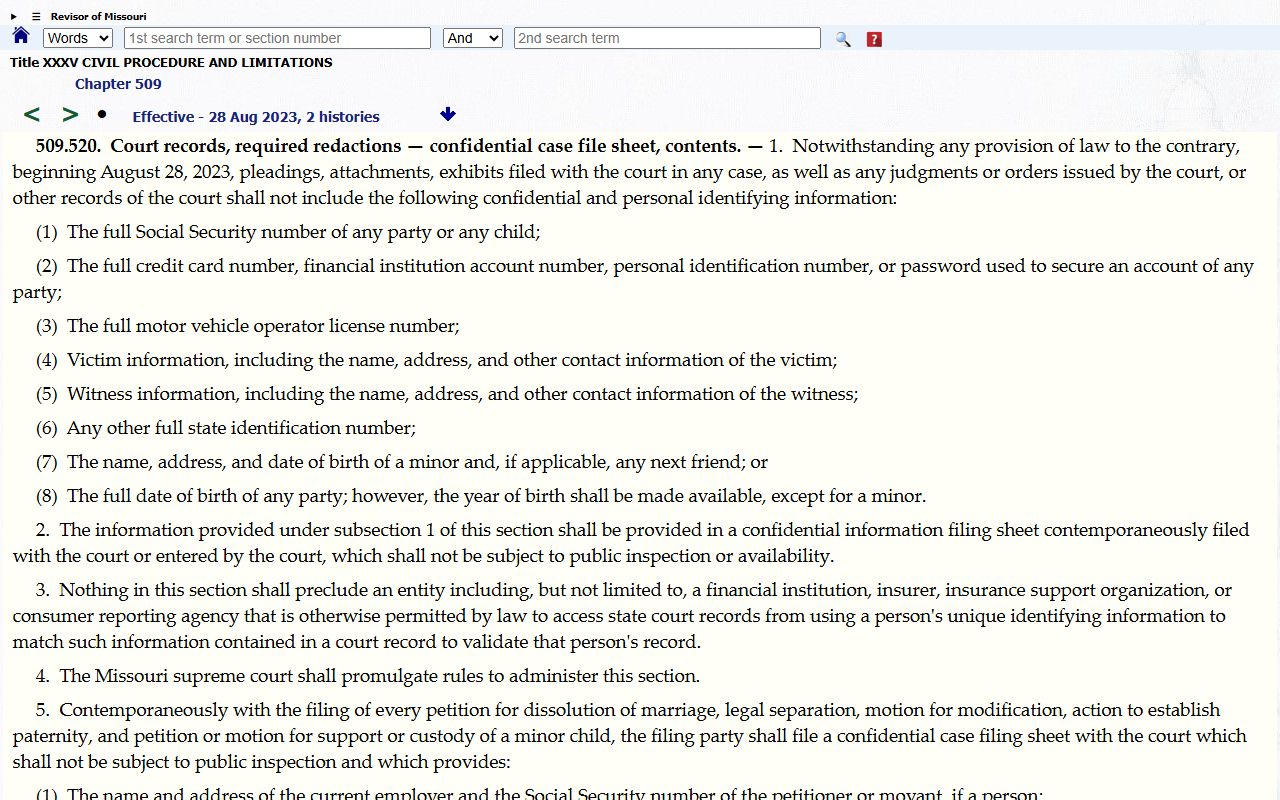
That statute supports the local practice of keeping sensitive identifiers out of the public version of court filings.
Search Shelby County Criminal Cases
The main online path for public Shelby County criminal court records is Missouri Case.net. Shelby County does not publish a separate county-run criminal case database in the research sources. Case.net is the statewide public access system for case numbers, parties, docket entries, hearing settings, judgments, charges, and some public case documents when remote access is allowed. Automated access was blocked during research, so the safest workflow is a manual portal search followed by direct confirmation with the Circuit Clerk when a copy or court appearance depends on the result.
- Open Case.net and choose a case-number search if the criminal case number is known.
- Use litigant name search when the case number is not known, then narrow results by Shelby County or the court location shown.
- Open the case detail and read the docket entries in date order, with attention to charges, pleas, hearings, warrants, orders, and disposition entries.
- Check whether the case belongs in Circuit Court, Associate Circuit Court, or a municipal matter tied to Shelbina or Clarence.
- Call the Shelby County Circuit Clerk at 573-633-2151 or 573-633-2251 for certified copies, older records, or public-access questions that Case.net does not resolve.
Municipal criminal or ordinance matters require extra care. Shelbina maintains a municipal court page, while Clarence has a current city page and a 2026 code provision saying ordinance violations are heard by an associate circuit judge at the county seat. A docket result may therefore need a call to the city court or Circuit Clerk before a reader assumes the hearing site, payment route, or active status.
Shelby County Criminal Case Flow
A Shelby County criminal court file is best read as a timeline. The charge begins the case, but later docket entries tell whether the charge stayed the same, was amended, was dismissed, ended in a plea, went to trial, or produced a sentence. The court days published by the county help explain the local rhythm: circuit court day is the second Thursday of the month, associate court day is every Wednesday, and juvenile law day is the second Tuesday. Those are regular local court days, not a guarantee for any one case.
Case flow: Charges Filed › Arraignment › Pretrial and Motions › Plea or Trial › Disposition › Sentencing
| Stage | What the Shelby County Record May Show |
|---|---|
| Charges filed | Complaint, information, indictment, count number, statute, charge description, and class when public. |
| Arraignment | The defendant's first court response, bond terms, counsel status, and next court date. |
| Pretrial | Motions, continuances, discovery entries, amended charges, hearings, and court orders. |
| Plea or trial | Guilty plea, trial setting, verdict, dismissal, or other charge-level outcome. |
| Sentencing | Jail, prison, probation, fines, costs, restitution, payment plan, or other judgment terms. |
What Shelby County Criminal Records Show
Missouri public case records commonly show a mix of party data, court activity, and outcome fields. In criminal cases, the most important fields are the case number, court location, defendant, attorney, charge list, docket text, hearings, disposition, sentence, bond, and financial obligations. Some public case documents may be available through remote access after Missouri's remote-public-access changes, but sealed, expunged, juvenile, adoption, mental-health, and redacted material remains outside ordinary public view.
| Field | What It Shows |
|---|---|
| Case number | The Missouri Case.net case identifier for the criminal matter. |
| Court location | Shelby County, the 41st Judicial Circuit, or a municipal division when applicable. |
| Defendant and attorneys | The public party name and lawyer information when not restricted. |
| Charges | Statute, description, class, count number, amended counts, dismissed counts, plea, or disposition. |
| Docket entries | Filings, motions, hearings, continuances, orders, warrants, recalls, dismissal, or judgment activity. |
| Sentence and financials | Probation, jail, prison, fines, costs, restitution, bond, payment plan, and balances when shown. |
Because Case.net blocked automated review during research, no live Shelby County sample case was scraped. That gap makes the field list an expected public-record inventory, not a promise that every public case shows each field.
Charges vs Convictions
A filed charge is an allegation. A conviction is a court outcome. Shelby County criminal court records can show charges that were reduced, amended, dismissed, or resolved without a conviction. This distinction matters for background checks, warrant questions, employment forms, and plain reading of the docket. A charge line should not be treated as proof of guilt unless the disposition shows a guilty plea, guilty verdict, or other conviction entry.
| Point | Charge | Conviction |
|---|---|---|
| Meaning | A prosecutor-filed accusation in court. | A guilty plea, guilty verdict, or finding entered by the court. |
| Where it appears | Charge list, complaint, information, indictment, or docket entry. | Disposition, judgment, sentence, or plea entry. |
| Can it change? | Yes. A count may be amended, reduced, or dismissed. | It may be appealed, set aside, or later expunged only through a legal process. |
| How to verify | Read every count and later docket entry. | Confirm the final disposition and sentence. |
Disposition and Sentence Reading
The disposition is the court outcome for the case or for a single count. A docket may show guilty, not guilty, dismissed, dismissed with prejudice, dismissed without prejudice, amended, or another outcome. Missouri research defines a disposition as the outcome of a charge or case, and a sentence as the punishment imposed after conviction. A dismissed count is not the same as a conviction. A suspended sentence, probation term, or payment order may still appear after a plea or finding of guilt.
For Shelby County records, the sentence section may be more than one line. It can include probation, jail or prison terms, fines, court costs, restitution, payment-plan entries, bond activity, and later compliance events. If the docket includes a warrant or recall entry, read the surrounding dates. A recall or quash entry may show that a warrant was resolved, but the clerk should confirm any status that affects an arrest risk, bond, or hearing date.
Sealed vs Expunged Records
Sealed and expunged records both limit public access, but they are not the same thing. Missouri section 610.140 covers many criminal-record expungement petitions. Section 610.123 separately addresses arrest-record expungement petitions, and section 610.130 addresses certain alcohol-related driving offense expungements. A person normally files in the court where charged or found guilty, identifies the records and agencies involved, and waits for the court process before any public access changes.
The Missouri expungement screenshot from section 610.140 is one of the assigned sources for Shelby County criminal court records.
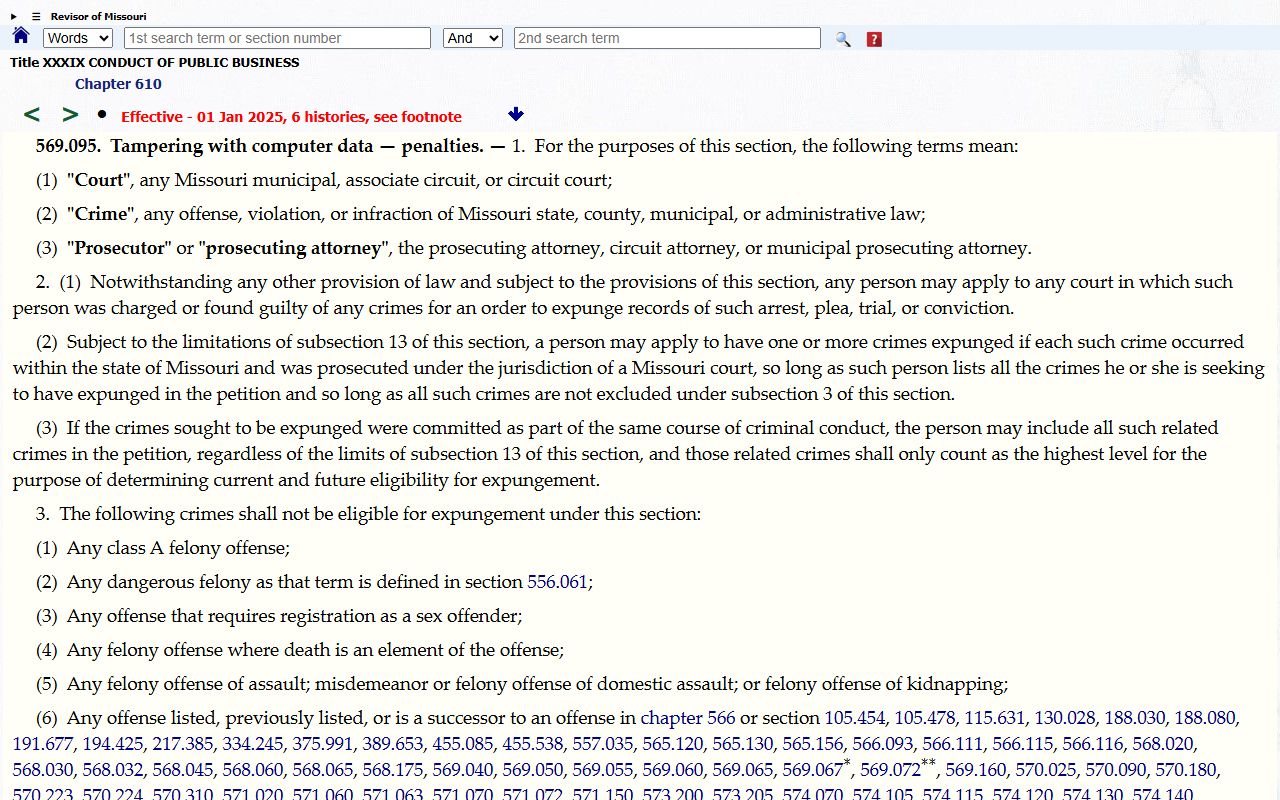
That source is useful because expungement changes public access but does not mean every agency record vanishes in the literal sense.
| Point | Sealed | Expunged |
|---|---|---|
| Public access | Blocked or limited by court order, statute, or rule. | Closed from ordinary public access after a granted expungement. |
| How it happens | By statute, rule, case type, or judge's order. | By petition and court order for eligible records. |
| Public lookup | May show limited or no case detail. | May be removed from ordinary public search results. |
| Legal advice | Ask an attorney about access or response duties. | Ask an attorney about eligibility, waiting periods, and exclusions. |
The assigned arrest-record expungement source at Missouri section 610.123 helps separate arrest-record cleanup from broader criminal case expungement.
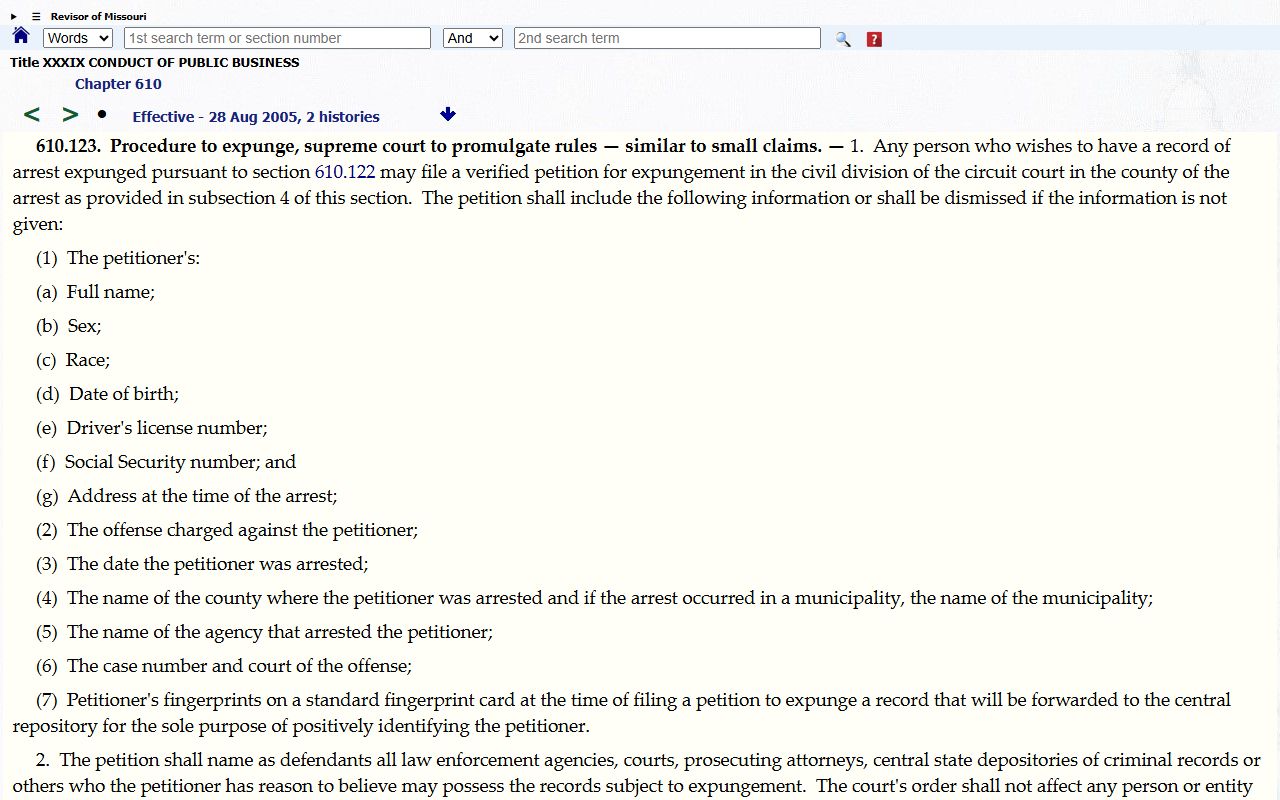
That distinction matters when an arrest occurred but no conviction appears in the Shelby County criminal court file.
Public Access to Shelby Criminal Records
Court case records should be separated from county administrative records. Court files start with Case.net and the Shelby County Circuit Clerk because judicial records follow court-access rules and confidentiality statutes. Non-judicial records, including some sheriff administrative records, may fall under Missouri Sunshine Law unless a specific law closes them. The public-record custodian matters: the Circuit Clerk holds court case files, the Sheriff holds some law-enforcement records, the Prosecuting Attorney files state charges, and the Department of Corrections holds state offender supervision data.
Key access rules: Missouri Constitution Article V, section 14 gives circuit courts broad original jurisdiction, while Missouri section 610.023 sets the general Sunshine Law response-time rule for public governmental bodies.
The assigned alcohol-related expungement source at Missouri section 610.130 belongs in criminal record review when the court file involves a qualifying driving offense.
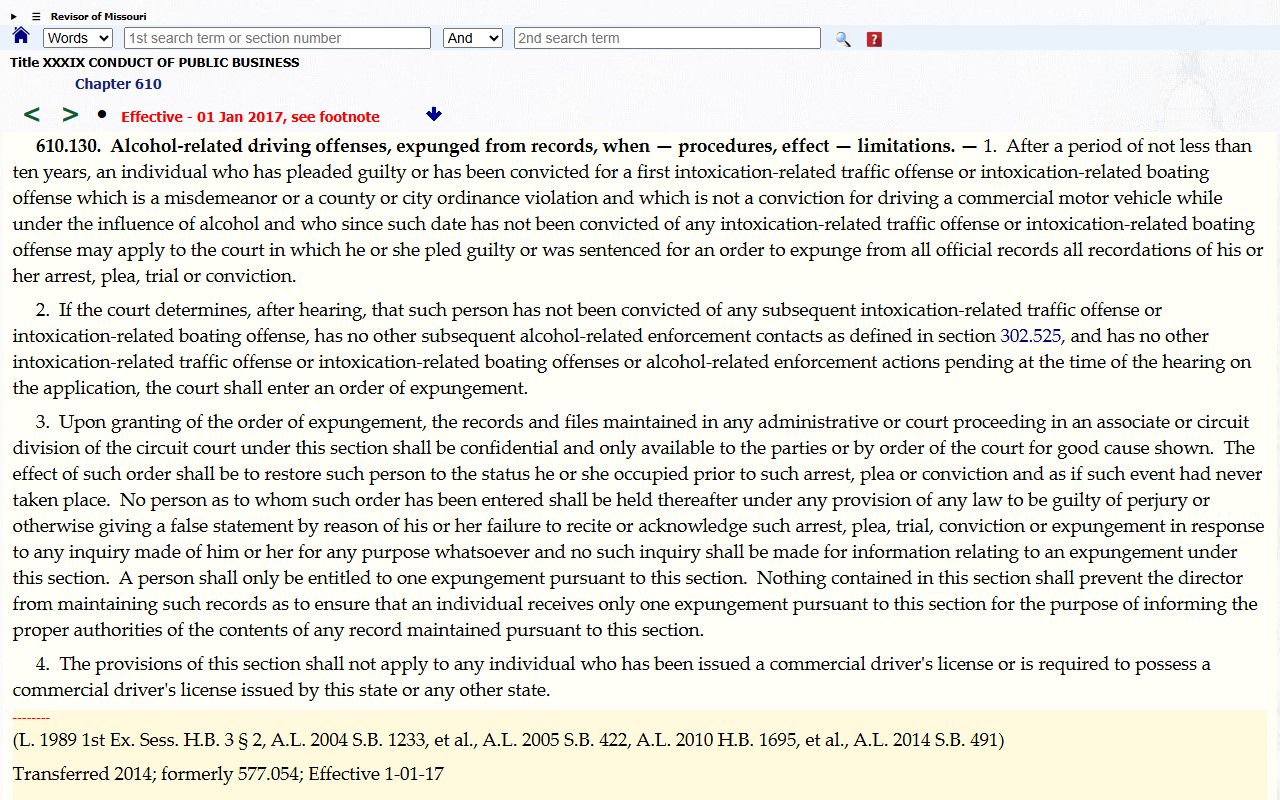
It is a narrow rule, so it should not be read as a general right to clear all traffic or DWI-related court history.
Restricted Shelby Criminal Court Records
Juvenile records are one of the clearest restrictions in the research. Missouri section 211.321 makes juvenile court records and related social records confidential except for court orders, statutory exceptions, and limited public information in certain serious matters. Section 211.319 also affects access to juvenile pleadings, orders, and files. Shelby County's local juvenile law day does not make juvenile court files open to ordinary public inspection.
The assigned juvenile confidentiality source at Missouri section 211.321 is central to public-access limits for Shelby County criminal and juvenile-adjacent court records.
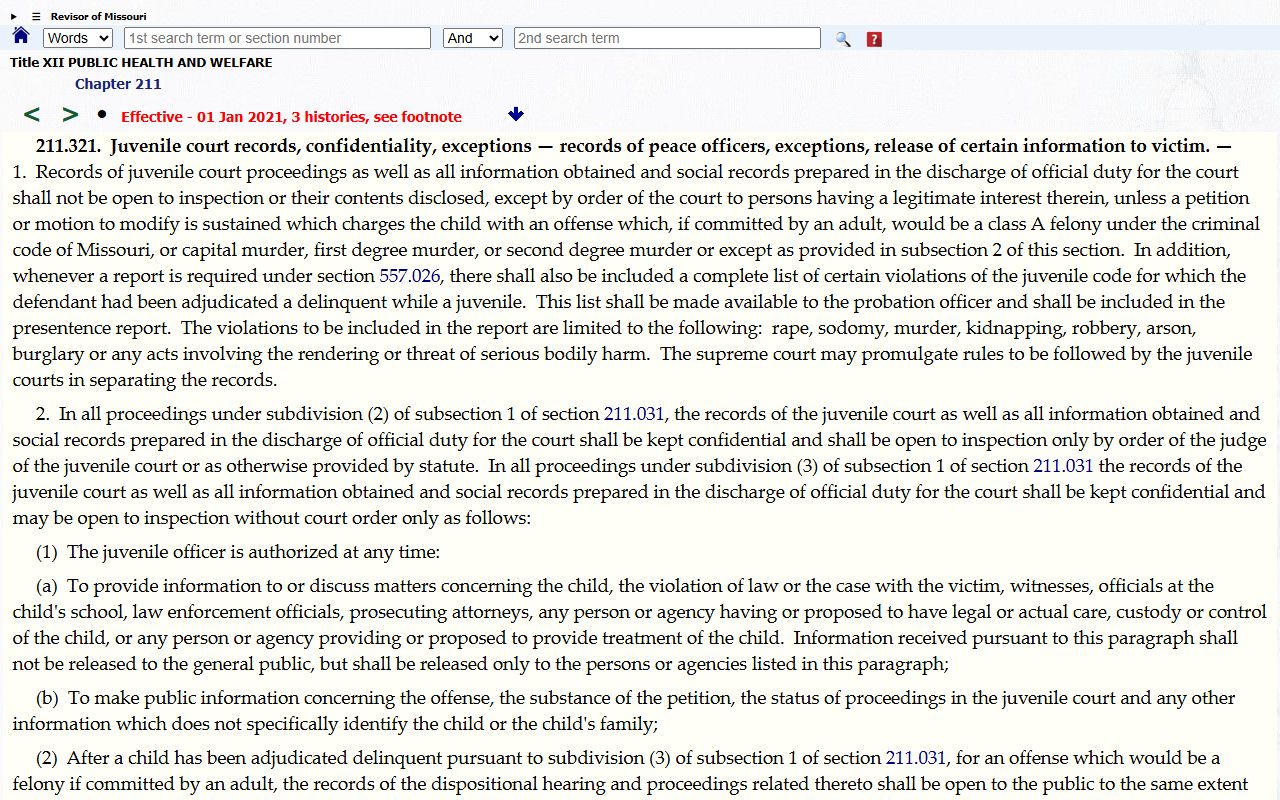
That rule explains why a name search may not return juvenile material even when a court event occurred.
The related source at Missouri section 211.319 covers juvenile pleadings and orders access.
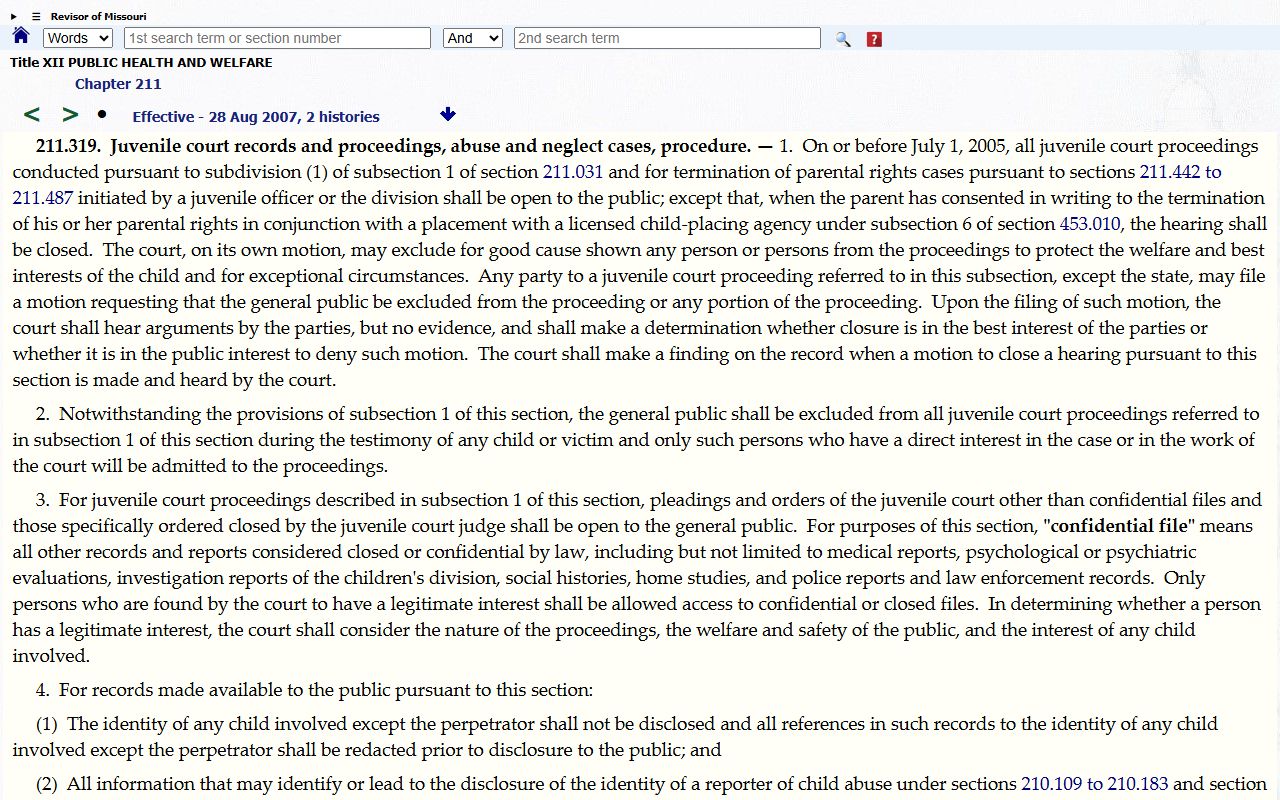
Together, those juvenile statutes create a sharper access boundary than the public rules that apply to most adult criminal cases.